
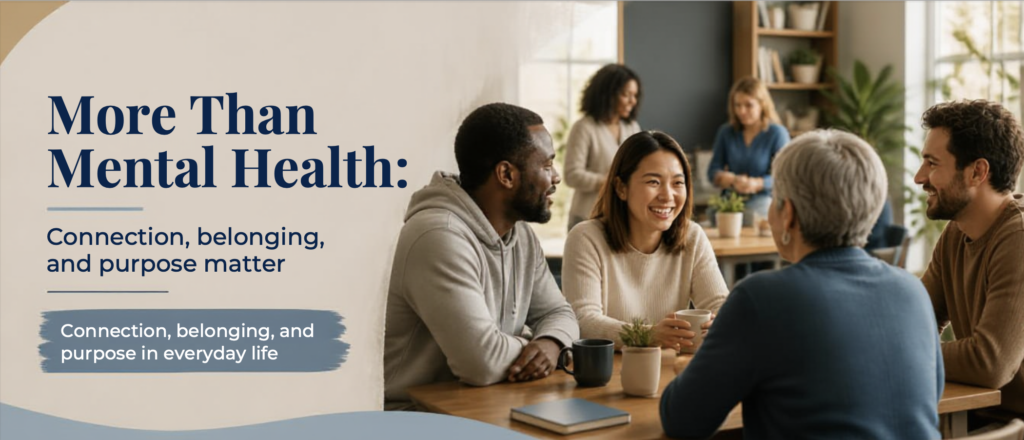
More Than Mental Health: Why Connection, Belonging, and Purpose Matter
Mental health is often discussed through the lens of illness—depression, anxiety, trauma,
stress, and other conditions that can disrupt daily life. Recognizing these challenges is
essential, and people experiencing mental health difficulties deserve understanding,
effective care, and support without judgment.
At the same time, mental well-being is about more than the absence of symptoms. A person
can have no diagnosis and still feel lonely, disconnected, discouraged, or unsure why they’re
getting up each morning. And someone living with a mental health condition can still
experience joy, meaningful relationships, hope, gratitude, and moments of deep belonging.
This broader view of well-being shifts the conversation from “How do we reduce suffering?”
to a more complete question: “How do we help people flourish—through connection,
belonging, and purpose—while ensuring professional support is available when needed?”
Key idea: Supporting mental well-being means both reducing suffering and creating
everyday opportunities for connection, belonging, and purpose—especially before a
crisis occurs.
Mental Well-Being Is More Than the Absence of Illness
It’s possible for two people to look “fine” on the outside and have very different inner
experiences. One person may feel supported by friends and family, enjoy daily routines, and
feel valued by their community. Another may be functioning at work or school, yet feel
isolated, unseen, and without direction.
This is why mental well-being is often described as having positive elements—not just the lack
of negative ones. Well-being can include a sense of meaning, emotional balance, healthy
thinking patterns, supportive relationships, and the feeling that your life has value to others.
When communities focus only on diagnoses, they miss people who are quietly struggling with
disconnection. When communities focus only on “positivity,” they risk minimizing real mental
health conditions. A more helpful approach makes room for both realities at the same time.
Loneliness Can Affect Anyone—even When They’re Not “Sick”
Loneliness isn’t always obvious. Someone can live in a busy neighborhood, attend events,
work with others every day, or have hundreds of online interactions and still feel deeply
alone. Loneliness often shows up when people don’t have relationships that feel meaningful,
when they feel misunderstood, or when they don’t have a place where they truly belong.
What helps isn’t always a grand solution. Often, it’s consistent, ordinary moments that
remind someone they matter.
- A conversation that goes beyond small talk
- A shared meal or simple invitation
- A regular activity where people are expected and welcomed
- Being noticed—someone realizes you weren’t there and checks in
Over time, these “small” experiences build something large: the feeling of being seen, heard,
valued, and included.
Connection Is Part of a Healthy Community
A healthy community is not simply a group of people living near each other. It’s a place where
people have chances to know one another, support one another, and participate in something
bigger than themselves. Connection grows when communities create frequent, low-barrier
ways for people to show up and be included.
Community connection can be especially meaningful for people whose social circles tend to
shrink over time or whose routines make relationships harder to maintain.
- Older adults
- People who live alone
- Newcomers
- CaregiversPeople experiencing major life transitions (loss, retirement, relocation, divorce, illness)
In many cases, people don’t need someone to solve their problems. They may need someone
to sit with them, a friend to call, a reason to leave the house, or a place where they feel
welcome without having to “earn” it.
Purpose Gives People a Reason to Keep Going
Purpose doesn’t have to mean achieving something extraordinary. For many people, purpose
comes from raising children, caring for a loved one or pet, learning a skill, creating something,
practicing a faith, contributing at work, volunteering, or simply being there consistently for a
friend.
Purpose can also change throughout life. After retirement, someone may need new ways to
contribute. After losing someone they love, direction may take time to return. After moving,
building relationships may be the first step toward feeling grounded again.
Communities can support purpose by inviting participation—not only providing help, but also
creating meaningful ways for people to contribute their skills, time, and experience.
Small Practices That Strengthen Well-Being
Research on well-being often points to everyday practices that can support resilience and
positive mental health: gratitude, acts of kindness, mindfulness, forgiveness, and identifying
personal strengths. These practices don’t replace care for serious mental health conditions,
but they can complement support in practical, accessible ways.
For example, someone can practice gratitude while receiving therapy, rebuild friendships
while seeking professional help, and take medication while also developing routines and
relationships that bring meaning and stability.
Important: Community connection and mental healthcare don’t compete with each
other. When used together, they can strengthen well-being in a more complete and
sustainable way.
Asking More Than “Are You Okay?”
“Are you okay?” can be a caring place to start—but it can also be hard to answer, especially
when someone is unsure what they’re feeling or worries they’ll be a burden. Questions that
focus on connection, belonging, and meaning can open the door more gently and more
clearly.Connection: Is there someone you can talk to this week?
- Belonging: Is there any place where you feel welcome—one person, one group, one
- activity?
- Meaning: What has been giving your days a sense of purpose lately?
- Hope: Is there anything you’re looking forward to, even something small?
- Support: Who checks in on you—or who could you reach out to?
These questions reinforce an important truth: people are not defined by their difficulties, and
well-being includes the full human experience—not just symptoms.
Building a Culture of Belonging
Improving mental well-being is not only an individual responsibility. Families, neighborhoods,
workplaces, schools, faith communities, nonprofit organizations, and local groups all shape
whether people feel connected—or invisible. Belonging grows when a community repeatedly
communicates, “You have a place here.”
One practical way to think about community well-being is to build opportunities across a few
pillars:
Pillar What it looks like in everyday life
Connection Regular chances to talk, share experiences, and build familiarity over time.
Belonging Welcoming spaces that include people across age, background, and circumstance.
Purpose Meaningful ways to contribute—volunteering, helping neighbors, sharing skills.
Support Clear pathways to help, including professional resources when needed.
Friendship Relationships that extend beyond a single event—consistency, follow-up, care.
Friendship Support Network: Creating Opportunities to Connect
At Friendship Support Network, reducing loneliness and strengthening community ties are
central to building healthier, more supportive communities. The goal is not to suggest that
friendship alone can solve every mental health challenge. Rather, people deserve access to
both professional support when needed and meaningful human connection in everyday life.
Often, community support begins with simple steps: a gathering that makes it easier to meet
others, a volunteer role that restores purpose, or a conversation that grows into friendship.
Over time, friendship can become a support system—and a support system can remind
someone they do not have to face life’s challenges completely alone.
Connection Should Begin Before a Crisis
One of the most important lessons of a whole-person view of well-being is that communities
shouldn’t wait until someone reaches a crisis to care about connection. Belonging can be
built before loneliness becomes overwhelming. Purpose can be encouraged before someone
feels completely lost. Welcoming communities can be created before someone has to ask for
help.
No community can prevent every painful experience. People will still face grief, stress, illness,
loss, and change. But communities can influence whether people have to face those
experiences alone—and whether they know where to turn when life gets hard.
Professional Support and Community Connection
Community connection is a powerful part of well-being, but it is not a substitute for qualified
mental health care. Professional support can be essential when someone is experiencing
persistent distress, intense symptoms, or difficulty functioning in daily life.
A healthy community makes room for both: everyday human connection that helps people
feel seen and supported, and clear access to professional care when needed. Together, these
supports create a stronger foundation for mental well-being—one that recognizes both
suffering and the deep human need for belonging.
References
1. 2. 3. 4. World Health Organization. Mental health. https://www.who.int/en/health-topics/mental- health
World Health Organization. Social connection. https://www.who.int/news-
room/questions-and-answers/item/social-connection
Centers for Disease Control and Prevention. Social Connection.
https://www.cdc.gov/social-connectedness/about/
Centers for Disease Control and Prevention. Promising Approaches to Promote Social
Connection. https://www.cdc.gov/social-connectedness/data-research/promising-5. 6. 7. approaches/index.html
National Institute on Aging. Loneliness and Social Isolation: Tips for Staying Connected.
https://www.nia.nih.gov/health/loneliness-and-social-isolation/loneliness-and-social-
isolation-tips-staying-connected?
medicalDiagnosis=&page=1&services=&sortBy=newest&topics=39&types=BSC.Blog
National Academies of Sciences, Engineering, and Medicine. Social Isolation and
Loneliness in Older Adults: Opportunities for the Health Care System.
https://www.ncbi.nlm.nih.gov/books/NBK557983/
Holt-Lunstad, J. (2022). Social Connection as a Public Health Issue: The Evidence and a
Systemic Framework for Prioritizing the “Social” in Social Determinants of Health.
Annual Review of Public Health, 43, 193–213. https://pubmed.ncbi.nlm.nih.gov/35021021/