
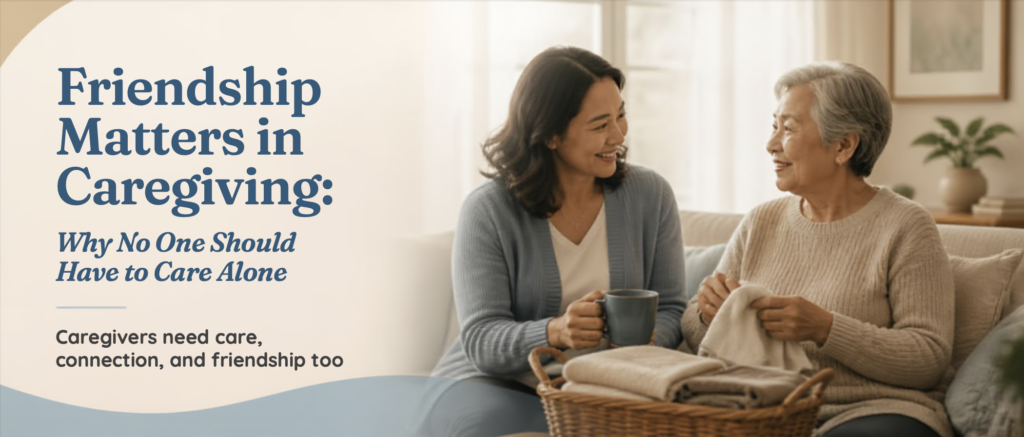
Friendship Matters in Caregiving: Why No One Should Have to Care Alone
Care is often framed as a family responsibility—but friends can be the difference between burnout and breath.
Caregiving rarely begins with a grand announcement. It starts with a ride to an appointment,
a quick check-in after a fall, a medication reminder, a “just for a few weeks” arrangement that
quietly becomes a new normal.
In the middle of all that change, one truth tends to surface: caregiving is hard to do alone. Not
because a caregiver isn’t capable, but because care is relational by nature. It asks for time,
patience, steadiness, and emotional labor—sometimes every day, often without certainty
about what comes next.
And yet, many caregivers still feel they should manage privately, “not bother anyone,” or keep
their struggle invisible. That’s where friendship matters—not as a feel-good extra, but as a
form of real support that makes caregiving more sustainable and more humane.
Pull quote: Friendship doesn’t replace professional support or family involvement—it fills
the human gaps that systems can’t reach.
What Friends Can Do That “Help” Often Misses
People often default to broad offers—“Let me know if you need anything.” It’s kind, but it puts
the burden back on the caregiver to identify needs, make a plan, and risk feeling like they’re
imposing.
Friendship support works differently. It’s relational, specific, and steady. Friends can
normalize the caregiver’s experience, notice what’s changing over time, and offer care
without turning the caregiver into a project to manage.
Here are a few ways friends uniquely strengthen caregiving—not by doing everything, but by
making caregiving less lonely and more shared.
Consistency — A weekly check-in text, a predictable meal drop-off, or a standing “walk-
and-talk” can be more helpful than a one-time grand gesture.
Emotional shelter — Friends can listen without fixing, without ranking someone else’s
suffering, and without needing the caregiver to “stay positive.
”Identity protection — A good friend remembers the caregiver is still a whole person: not
only a helper, not only a coordinator, not only “the strong one.”
Reality checks — Friends can gently reflect what they see: exhaustion, overwhelm, or
changes that signal it’s time for extra support.
How to Show Up as a Friend (Without Creating More Work)
The best support is concrete, time-bound, and easy to accept. It respects the caregiver’s
routines and the care recipient’s dignity. It doesn’t require the caregiver to host, entertain, or
manage you.
| Try this | Instead of this |
| “I can stay with them Tuesday 4–6pm or Thursday 10–12. Which helps more?” |
“Let me know if you need anything.” |
| “I’m at the store—do you want me to drop off fruit, soup, or freezer meals?” |
“You should take better care of yourself. ” |
| “I can make two calls this week—insurance, pharmacy, or scheduling. Pick the hardest one“ |
“Have you tried…?” (unsolicited advice) |
| “I’m free for 15 minutes. Want to vent, talk about something else, or sit quietly?” |
Silence until there’s a crisis |
Support Needs Boundaries, Too
Friendship in caregiving isn’t about rescuing. It’s about showing up in a way that’s sustainable
for both people. That means being honest about what you can do, keeping promises, and not
disappearing when the situation becomes ongoing.
It also means respecting privacy. Caregiving is intimate. Before sharing updates with others—
even with good intentions—ask what the caregiver wants shared and with whom.
Pull quote: The goal isn’t to be a hero. The goal is to be reliable.
When Friendship Becomes a Lifeline
Sometimes friendship is the bridge to broader help. A friend can encourage a caregiver to see
a doctor, join a support group, ask family members for specific coverage, or speak with a
social worker about options. A friend can also help identify when the caregiver is in distress—
especially if the caregiver has been minimizing their own needs for months.
If you notice persistent hopelessness, panic, severe sleep loss, or talk of self-harm, take it
seriously. Encourage professional support, and in urgent situations seek immediate local
emergency assistance.
References
1. 2. 3. 4. 5. Family Caregiver Alliance. Caregiver statistics: Demographics.
https://www.caregiver.org/resource/caregiver-statistics-demographics
National Alliance for Caregiving & AARP . Caregiving in the U.S.
https://www.aarp.org/caregiving/research/info-2020/caregiving-in-the-united-states.html
Centers for Disease Control and Prevention. Caregiving.
https://www.cdc.gov/aging/caregiving/index.htm
National Institute on Aging. Caregiving. https://www.nia.nih.gov/health/caregiving
American Psychological Association. Stress effects on the body.
https://www.apa.org/topics/stress/body